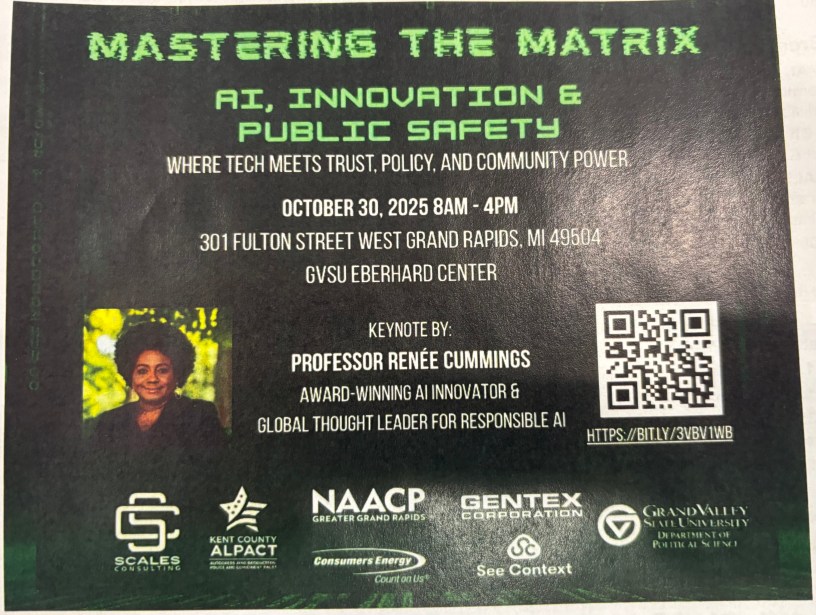

Today, as I continue moving through my final days as Chair of the Michigan Civil Rights Commission, I was asked to provide some opening remarks at a conference in Grand Rapids. The Kent County ALPACT (Advocates and Leaders for Policy and Community Trust) hosted “Mastering the Matrix: AI, Innovation & Public Safety” to spur discussion on best practices for AI and public safety and services. The Michigan Department of Civil Rights has been supporting the creation of ALPACT chapters in several communities across the state and this was the first time that one of the chapters held an event to start public policy discussions on the impact of AI on the world of civil rights and policing.
Here’s what I had to say today to help kick off the event:
Good morning, everyone. I’m Dave Worthams and I’m happy to join you today as the Chair of the Michigan Civil Rights Commission.
It is truly an honor to welcome you to today’s Summit on Artificial Intelligence and its impact on equity, trust, and accountability in our state. We find ourselves at the crossroads of technology, justice, and human dignity, begging the question of where we go from here?
Over the past few years, our world has been transformed by artificial intelligence — its power to analyze data, make predictions, and influence decisions now reaches into nearly every aspect of public life.
AI shapes how we keep our communities safe… how we deliver public services… how we hire and educate… and even how we define fairness itself.
Before we dive into today’s discussions, I want to take a moment to share with you who the Michigan Civil Rights Commission is and why these issues matter so deeply to us.
The Michigan Civil Rights Commission, created by the 1963 Constitution of the State of Michigan, is charged with safeguarding the civil rights of all Michiganders. We are a bipartisan body of eight citizens — appointed by the Governor and confirmed by the State Senate — united in one mission: to investigate discrimination and to secure the equal protection of civil rights guaranteed under Michigan law.
We serve as both a guardian and a voice — ensuring that every Michigander can live, work, and thrive free from discrimination based on race, religion, color, national origin, sex, age, disability, gender identity or sexual orientation or any other protected characteristic.
The Michigan Department of Civil Rights, or MDCR, serves as the operational arm of the Commission.
It’s the Department that carries out our policies, investigates complaints, educates communities, and provides leadership and training to prevent violations before they occur.
In short — the Commission sets the vision, and the Department makes that vision real.
Together, we form a partnership that stands at the intersection of justice and public service — working every day to make Michigan a place where opportunity and equality are not just aspirations, but expectations.
So, why is the Civil Rights Commission so focused on artificial intelligence?
Quite simply, because as technology evolves, so do the ways in which bias and inequity can appear.
When I first became Chair, one of the earliest questions we faced was whether our civil rights laws — many written before the first personal computer was invented — were ready for algorithms that predict crime, screen job candidates, or decide access to credit and healthcare.
Our answer was clear: our principles are timeless, but our tools must evolve.
That realization led to the Commission’s first Resolution on Artificial Intelligence and Civil Rights, adopted in 2023.
In that resolution, we called for the following:
- Transparency and accountability in any government or private use of AI that affects people’s access to justice, employment, housing, education, or healthcare.
- Public notice and meaningful consent when AI systems are used to make or inform decisions about individuals.
- Regular bias and impact audits for all AI tools used by state or local agencies — especially in law enforcement and human services.
That was our first statement of principle. But we didn’t stop there.
A year later, in 2024, we adopted a second resolution — focused on ethical and equitable use of AI in public safety and social systems.
We reaffirmed that protecting civil rights is not an obstacle to innovation — it’s the blueprint for innovation that endures.
We urged that AI in public safety should enhance community trust, not replace it.
That predictive policing tools should never become instruments of over-policing.
And that automated decisions in child welfare or benefits programs must always be transparent, reviewable, and subject to human oversight.
Those resolutions were shaped by voices from every corner of Michigan — technologists, community leaders, law enforcement, and advocates — all sharing one conviction: technology must serve humanity, not the other way around.
We are entering an era when algorithms can analyze patterns faster than any detective, when predictive models can identify who might be at risk before tragedy strikes, and when digital tools can extend the reach of our teachers, caseworkers, and police departments.
These are remarkable opportunities.
But they come with equally profound responsibilities.
Because if left unchecked, AI can also encode our worst biases with the speed of a microchip.
It can amplify disparities we’ve spent generations trying to dismantle.
And it can make discrimination look like data that supports unjust actions.
That is why the Michigan Civil Rights Commission has made this a priority.
We know civil rights enforcement must evolve — and that the same values that guided us through the Civil Rights Movement must guide us in the Algorithmic Age:
- justice
- equity
- accountability
- and the unshakeable belief in human dignity.
We must ensure the technology that predicts a person’s future does not erase their humanity.
We must ensure innovation does not mean invisibility for those on the margins.
And we must ensure that public safety remains rooted in public trust, not just public data.
The good news is that Michigan is not standing still.
Across our universities, companies, and government agencies, innovators are working to design AI that’s fairer, more explainable, and more human-centered.
This is what human-centered innovation looks like — it starts with humility.
It starts by asking not just “Can we build it?” but “Should we — and how can we build it justly?”
Three guiding principles have emerged from our work:
First, transparency is non-negotiable.
Communities have a right to know when AI is being used, what data it relies on, and how it affects their lives. Transparency is the oxygen of democracy; without it, trust cannot breathe.
Second, accountability must be shared. It’s not enough to say “the algorithm did it.” Every AI system reflects human choices. Accountability means clear responsibility, oversight, and redress when harm occurs.
And third, innovation must be human-centered.
AI should enhance human judgment, not replace it. It should make our public systems more equitable, not just more efficient. That means co-designing technology with the communities most affected — ensuring diversity in those who build these tools — and measuring success not in accuracy alone, but in fairness.
The promise of AI is not simply in what it can calculate — but in what it can illuminate about who we are and who we aspire to be.
So, as we begin this summit, let us make Michigan a model for using AI wisely, fairly, and transparently.
Let us show that civil rights and innovation are not competing priorities — they are complementary ones.
Because in the end, justice is not automatic.
It is something we must design, protect, and continuously renew.
That is our charge as a Commission.
That is our charge as public servants.
And that is our charge as citizens of a shared future.
With that my friends, I again welcome you to “Mastering the Matrix”. We are proud to partner with Kent County ALPACT and the other sponsors of today’s event. I hope you gain knowledge from the speakers that you meet today and will leave empowered to bring your light and your hope and spread it throughout your communities.
Thank you for being here! God bless you and may God bless the state of Michigan.
 DaveWorthams.com