What is This “Diaconate” Inquiry Thing All About
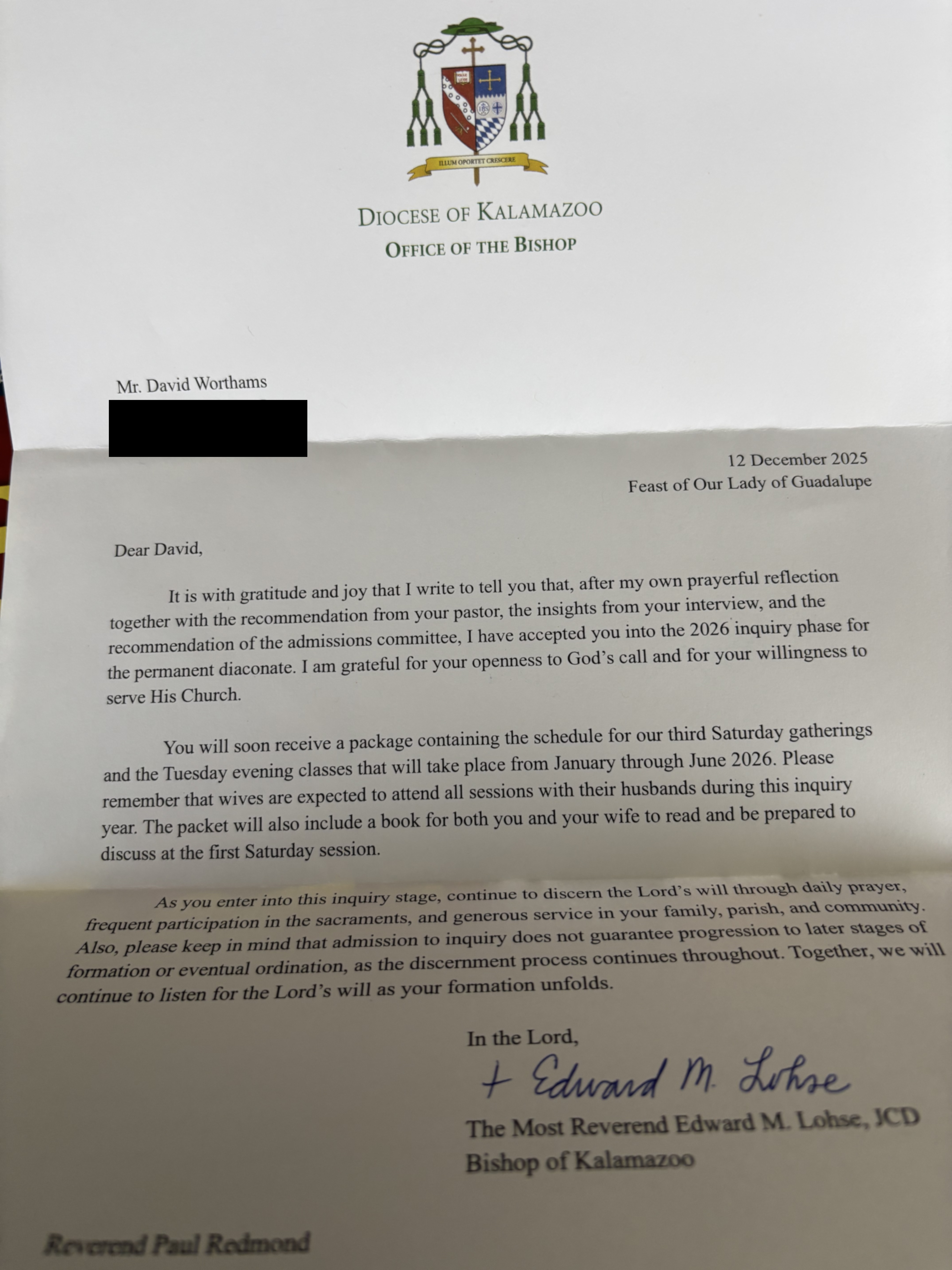
A few days before Christmas ‘25, I received a letter from His Excellency, Edward Lohse, the Bishop of Kalamazoo. His letter marked the conclusion of the initial phase and the start of the next steps of a personal journey that began almost four years ago when, between memories of my Grandma’s voice and of the night I was accepted into the Catholic Church by then Bishop Paul Donovan, and several conversations with folks whose advice I cherish, I decided to inquire about becoming a Permanent Deacon in the Catholic Church. I’m sure that I’ll write about the perfect storm of events, voices, and thoughts that came together somewhere down the road.
But for now, let’s begin with the Bishop’s letter.
As Niki will tell you, the sense of relief and excitement was pretty overwhelming! Our initial application was submitted in 2023 under the previous Bishop and we had to start all over again in 2025 after Bishop Lohse had redesigned the diaconate formation program.
As we shared the news with family, friends, and colleagues, including those who are Catholic and those who are not, we discovered that there’s a lot of questions people have about what is a Permanent Deacon. What do they do? How long is this going to take? What will you do when you get to the end, etc. etc. and so forth? As I answered these questions, the creative part of my brain engaged and came up with the idea that a new running series of blog posts — kinda a Dave’s F.A.Qs. — might make it easier to answer the common questions and help me capture my thoughts as we discern if this is indeed what God is calling me to do.
So, with the help of the book 101 Questions & Answers on Deacons by Deacon William Ditewig and the National Directory for the Formation, Ministry, and Life of Permanent Deacons in the United States by the US Conference of Catholic Bishops, please enjoy this first version of “Dave’s F.A.Qs.”
Just What the Heck is a Deacon?
Here’s how Deacon Ditewig puts it:
A Catholic deacon is a member of the clergy. In the Catholic Church, “the clergy” consists of three groups of ordained ministers: bishops, deacons, and priest. While all members of the Church are called to minister to others by virtue of their baptism, some Catholic are also ordained too specific forms of ministry to the rest of the Church. We refer to these ordained Catholics as “clerics” or “clergy.”
The title “deacon” comes from the Greek word diakonos, which means servant. A deacon is ordained by the bishop into the Order of Deacons (sometimes referred to simply as the “diaconate”), much like a priest is ordained into the Order of Presbyters (the “presbyterate”), and a bishop is ordained into the Order of Bishops (the “episcopate”). (Ditewig, 2004, p. 11)
OK, So What Do They Do?
Again, pulling from Ditewig:
He is permanently and publicly configured to Christ the Servant, he shares in the overall pastoral responsibility of the bishop to care for all the people in the diocese, and he becomes an integral part of the clerical structure of the Church, in partnership with priests, serving the needs of the entire diocese. (Ditewig, 2004, p. 11)
To get more specific in what can a deacon do, from The National Directory:
[The deacon] is called to proclaim the Scriptures and instruct and exhort the people. This finds expression in the presentation of the Book of the Gospels, foreseen in the rite of ordination itself. . . . [He is called to] the solemn administration of baptism, in the custody and distribution of the Eucharist, ini assisting at and blessing marriages, in presiding at the rites of funeral and burial and in the administration of sacramentals. . . . [Finally, he is called to dedication to works of charity and assistance and in the direction of communities or sectors of church life. (United States Conference of Catholic Bishops, 2021, p. 25)
Ok Dave, Can You Put That In English?
Once ordained, I will be able to :
- Proclaim the Gospel at Mass
- Give a homily at Mass
- Distribute the Eucharist at Mass (give people communion)
- Witness marriages
- Perform baptisms
- Lead funeral services (but not a Mass)
- Give blessings
But being a Deacon is more than just what I can do or the abilities I’ll gain. This is more than just part-time ministry. At our first formation session and after reading Ditewig’s book, we really learned: Don’t think of this as what a Deacon does and more as what a Deacon can be … you become a different person.
How Long is it Going to Take You to Become a Deacon?
The formation team covered this in our first class, so it’s still fresh in my head. While the program is still evolving, the TLDR answer: if everything goes well, the cohort that I’m in will be ordained in May, 2031.
The longer answer, there are three phases (for lack of a better term) to diaconate formation:
- Application & Inquiry (1 Year) – This phase is focused on learning what it means to be a deacon and to help establish a strong spiritual and prayer life. It’s also a chance for the Diocese to get to know me and Niki.
- Aspirancy (2 Years) – This phase gets into the theology of being a deacon. The first year focusing on the Bible, the second year focusing on the Catechism of the Catholic Church.
- Candidacy (3 Years) – This phase gets into the logistics of how to be a deacon.
Wait a Tick, You’re Married to Niki. How Can You be Ordained?
While clerical celibacy has become the norm in the Roman Catholic Church, if you take a look at Eastern Catholic Churches, married clergy actually are the norm. For Roman Catholics, priests and bishops take a vow of celibacy, deacons may be married when they are ordained. Picking up from Ditewig:
. . . Notice cannon law does allow married men to be ordained to the permanent diaconate; but normally, once ordained, a man cannot marry. This means that if a deacon’s wife dies, the normal course is for the deacon to remain celibate. under certain conditions, a deacon’s bishop may petition the Holy See for a dispensation from canon law so that the deacon might marry again, but this is an exception and not the norm. (Ditewig, 2004, p. 73)
So How Does Niki Feel About This Thing?
You’ll need to ask her about her thoughts, but I can tell you both the Kalamazoo diocese and the USCCB require that I comply with her wishes when it comes to becoming a deacon. From the National Directory:
. . . The Church has determined that a married man cannot be considered for the diaconate without the consent of the wife. The consent offered by way of a wife’s signature should be reflective of her participation and presence at some level. (United States Conference of Catholic Bishops, 2021, p. 81)
At the end of each step of the formation, both Niki and I will be interviewed to see if we wish to continue and Niki will need to put down in writing that she’s still down with what we’re doing.
Are You Still Going to Be A Lobbyist After You Become a Deacon?
Yes. Many deacons continue to work … after all, there are bills to be paid. I know of a couple of Lansing lobbyists who are deacons and they’ve been successful around the Capitol and in their ministries as well.
Plus, you should see my student loans that I’m still paying on. I’m gonna need to work until I’m at least 72 1/2! 😉
These are the questions we get the most and I’m sure there will be more as we continue this journey. So stay tuned for more.
And do me a favor. If you get the chance, say a couple of prayers for Niki and I as we discern this pathway.
Sources:
- Ditewig, W. T., Ph.D (2004). 101 Question & Answers on Deacons, Paulist Press.
- United States Conference of Catholic Bishops (2021). National Directory for the Formation, Ministry, and Life of Permanent Deacons in the United States of America (2nd ed.).
 DaveWorthams.com